Showing posts with label Texas. Show all posts

Thursday, June 24, 2021

Jurassic World The Exhibition

 Check out Dino Dad Review's visit to Jurassic World: The Exhibition at the Grandscape - The Colony near Dallas, Texas! This is one dinosaur attraction that's sure to get a lot of buzz, so don't miss out! 

Jurassic World: The Exhibition 


Saturday, August 1, 2020

Dino Dino Dino (Dad Reviews)

Time for more self-promotion! I guess it's been a while; there's quite a few more books featured at Dino Dad Reviews than the last time I did this!

I've managed to find multiple books over the past year celebrating the often overlooked contributions of women in paleontology. Daring to Dig has proved the most popular of these so far, which tells the stories of several women important to the history of American paleontology. She Found Fossils is pretty similar, though it expands its focus worldwide, and covers many more individuals (including scicomm celeb Ashley Hall, who just released her own book, Fossils For Kids). The Dinosaur Expert is a storybook about a girl embarrassed by her interest in dinosaurs that demonstrates the value of representation in the field, and an information page at the back mentions many of the paleontologists mentioned in the previous two books. Fossil Huntress tells the story of famous paleoanthropologist, Mary Leakey.

Additionally, I've reviewed multiple books about Mary Anning, the matriarch of paleontology, over the past year or so. Stone Girl, Bone Girl and The Dog That Dug For Dinosaurs are somewhat meh, while Mary Anning's Curiosity and Dinosaur Lady are excellent (even if the latter perpetuates the erroneous association of Anning with dinosaurs).

I've published a few more reviews on museums and other attractions, including Dinosaur Valley State Park, the creationist ICR Discovery Center, the socially-distant drive-thru version of Jurassic Quest, and the Texas Through Time museum.

I completed my trifecta of Abby Howard comics with Mammal Takeover!, and reviewed another Ted Rechlin comic, this time about the famous Sue the T. rex! I also reviewed another of Hannah Bonner's cartoon prehistory books, When Bugs Were Big, Plants Were Strange, and Tetrapods Stalked the Earth.

I've reviewed a fair number of different forms of media recently as well. Continuing my Primeval Playlist series, I was super excited to cover the geologically themed music of The Amoeba People, and also wrote a separate post about miscellaneous prehistory-themed music. The creator of THE BIG DIE produced a new humorous paleo game called Lemme Splash!, which mocks the crackpot Brian J. Ford and his idea of dinosaur "sex lakes". I've begun reviewing documentaries as well, starting with the Ark Encounter expose We Believe In Dinosaurs, and most recently Emily Graslie's Prehistoric Road Trip. Perhaps most significantly, I covered the inaugural Dino Nerds for Black Lives livestream, an online event which saw all sorts of paleo nerds doing various live presentations to raise money for BLM charities.

Just for fun, I engaged in some coloring activities, including The Coloring Book of (Scientifically Accurate) Paleofauna. I also reviewed several dinosaur toys: the Battat Dinosaurs 5-Pack and the Wild Past Protoceratops.

I suppose that's good enough for now. I'll keep coming back her to make more of these posts in the future. I hope you enjoy my reviews!


Friday, May 13, 2016

Waco Mammoth National Monument

     Jacy and I recently took a trip down to Austin for a Safe Staffing rally at the state capitol, which was my first visit to the area. We had a decent turnout considering this was the first such event, and my lovely wife was invited to the stage to give a quite eloquent talk on the subject. Frustratingly, I ran out of storage space on my phone halfway through, but the event itself was largely a success.
     I was particularly excited for our drive down, however, as the Waco Mammoth National Monument was on our way! This smallish museum is built over the site of a Pleistocene (Ice Age) excavation site, where a number of prehistoric mammals were found, especially of course mammoths.


     It's five bucks per person for the guided tour. I think you're allowed to walk around by yourself for free, though I don't really remember for sure. (Check with the ticket office just in case.)


     The original dig site was actually located just outside of the front entrance of the main building (Jacy and Xander are facing roughly in its direction). Seventeen Columbian Mammoths were found, two of which were juveniles, and all the adults were female. This was the first mammoth "nursery herd" ever discovered, confirming the long-held suspicion that mammoths behaved just like modern day elephants, whose females formed herds with their young, and males wandered off on their own upon reaching adulthood. You may have noticed I said "Columbian" Mammoth rather than "Woolly". Woolly Mammoths can be found in the northern latitudes worldwide, while Columbian Mammoths are exclusive to North American. They were larger than the Woollies, and lived further south, and so presumably had less hair, though since none of them had the decency to freeze in a glacier, we don't know for sure.


     After the initial herd was fully excavated, multiple individual mammoths were discovered nearby, as well as other prehistoric creatures. A building was erected over the site, and excavation ground to a halt as they ran out of room at Baylor University to store the bones. Currently, researchers are working on getting the excavated bones prepared for display. In the meantime visitors to the site get to see the remaining fossils in situ, as well a work-in-progress excavation site protected from the elements.


     The largest animal left in the pit is an old approximately 45-year-old male designated Mammoth Q, and curiously, was found with a baby mammoth resting on its tusks (most of the baby's body has already been removed by the scientists). Both presumably drowned when the nearby river flooded. Female elephants often will use their tusks to try to lift their babies out of harm's way when they are in distress, but for a male to do this would be unprecedented. It's also possible that their bodies simply bumped into each other as they were washed away. The jury's still out on that one.


     Accompanying the mammoths is a very nice specimen of the extinct American camel called Camelops. The camel is at the bottom of the picture, Mammoth Q & the baby are in the upper left. Another juvenile mammoth occupies the upper center of the picture. "Accompanying" may indeed be the right word, as Camelops fossils are often found alongside Columbian Mammoths, leading some to theorize they engaged in a symbiotic relationship. According to this theory, the camels would act as lookouts, while the mammoths would provide the muscle. Fun fact: camels actually originated in North America. While those that remained here eventually died out, some migrated to Asia & the Middle East where they still survive, while others migrated to South America and are now known as llamas.


     There was a nice exposed mammoth skull lying near the back that allows visitors to get a good look at the overall shape. Note that the skull is upside-down; you can see the molars just behind the tusks.


     This lovely (though somewhat sad) mural overlooks the excavation site. The scene depicts the original nursery herd at the moment it was caught and overwhelmed by the river as it jumped its banks in a flash flood. A Camelops makes a cameo in the waves behind the mother mammoth on the left.


     Here's the whole family in front of a life-sized representation of a full-grown Columbian Mammoth. It really gives you an impression of just how massive and awe-inspiring these creatures were! This painting takes into consideration the warmer climate of their southern home, and so it has much sparser hair compared to a Woolly Mammoth, rather closer to a modern elephant.


     At the end of the tour, we had Xander stand next to a mammoth femur for a little comparison photo, and in a moment too cute not to post, he went and hugged it instead! He seemed to like it. I certainly enjoyed the museum, and I look forward to seeing again next time we drive down to Austin!

Wednesday, April 27, 2016

More Dinosaur Doodles

Here's a few more Texas dinosaurs I've drawn recently, with varying degrees of success in this batch.

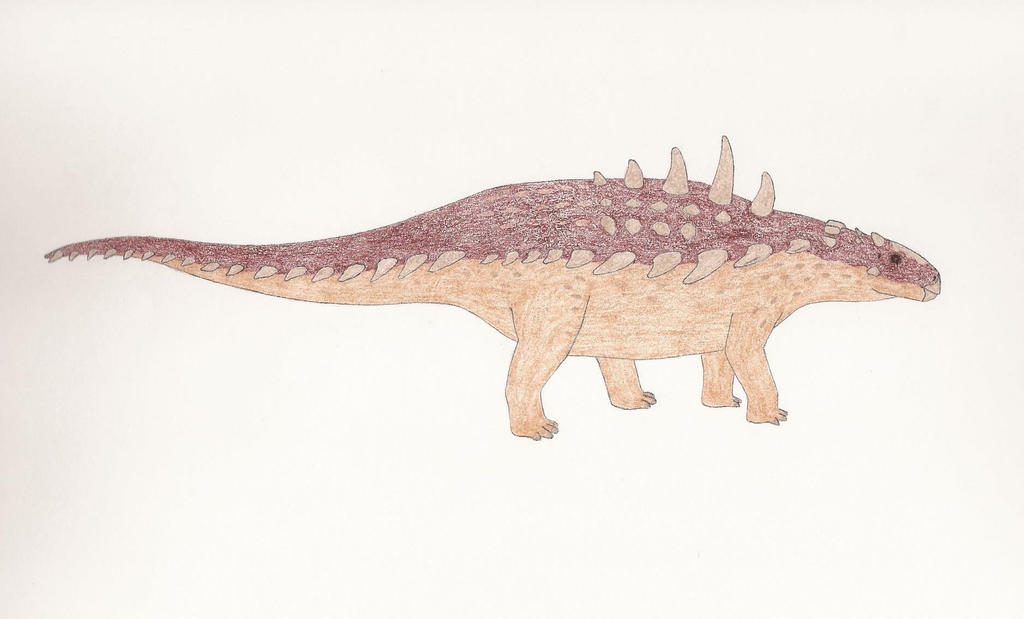
Gastonia

     First up, a dinosaur that may not even be from Texas! Somewhere along the way, I thought I'd heard it was found around here somewhere, but now I can only find references to it as being from Utah and Colorado. Oops! Well, it's my favorite of this batch, so I'm including it anyway. Ankylosaurs are always a pain to draw, what with all the knobs and spikes all over the place, so I'm pretty pleased with myself for sticking with it and producing something that looks halfway decent. I think I managed to hit upon a reasonable-but-interesting-looking color scheme to go with it as well. (To justify myself somewhat, even if Gastonia never made it down to Texas, it did cross paths with the next dinosaur in this post, which HAS been found in Texas, so there.)

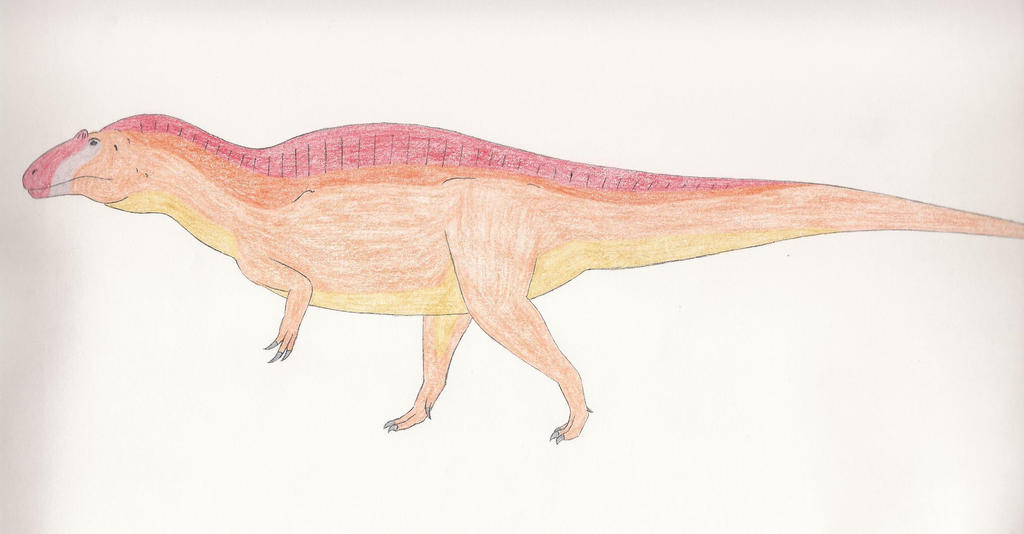
Acrocanthosaurus

     Acrocanthosaurus was originally dicsovered in Oklahoma, and is the official State Dinosaur there, but it also ranged through Wyoming and Texas, and perhaps even further afield. It's most well-known for its distinctive ridge-back, and it was the top predator in its time. Most believe it was responsible for the large theropod tracks at the famous Paluxy River dinosaur trackway site. I'm not sure I like how the color scheme came out on my drawing here. I think I should have made the colors grade into each other a little more gradually perhaps.

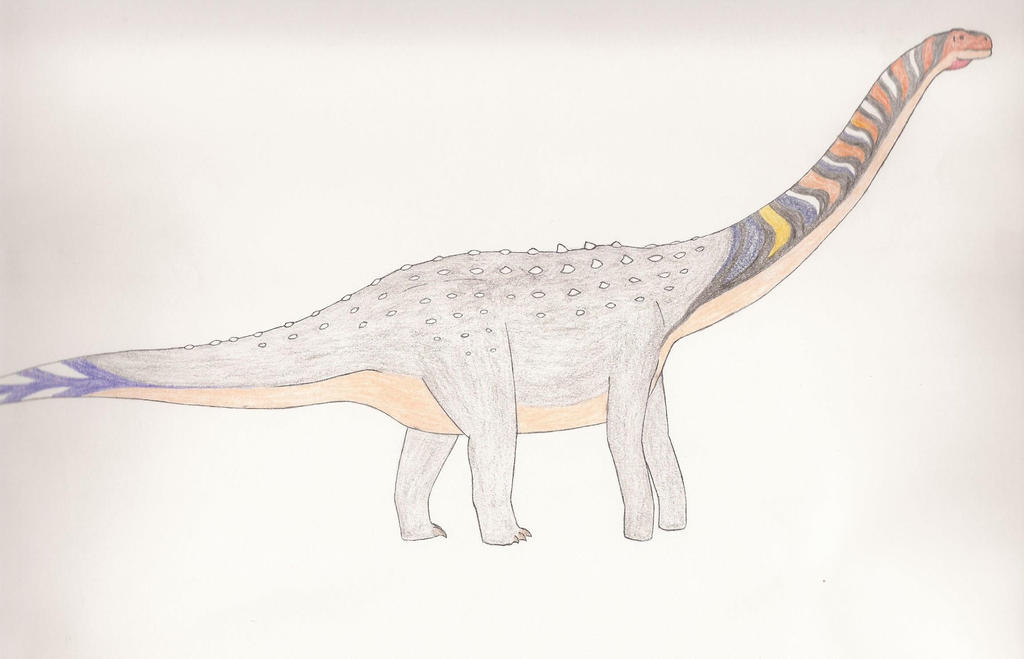
Alamosaurus

     Remember the Alamosaurus!!! Actually, contrary to popular belief, Alamosaurus was not named for the site of the famed Texas battle, but rather for the Ojo Alamo formation in New Mexico where it was originally discovered. By happy coincidence, it was later discovered in Texas as well, though still not particularly close to the Alamo of historic legend. The interesting thing about Alamosaurus is that it appeared rather suddenly in North America after an apparent 40 million year absence of sauropod ("brontosaur") dinosaurs from the continent, leading some to suspect it had migrated from South America where the sauropod lineage was still going strong. It appears to have had pebbly "armor" in the form of small bony knobs speckled across its back. For my drawing, I attempted to avoid the old trope of the boring grey long-neck, and added some fancy colors to the neck and tail for a mating display (a good use of all that advertising space). I'm not sure I like the end result however; I feel like I could've made it look more realistic somehow while still keeping it interesting. Oh well. Next time, maybe.

     Hope you liked these! Stay tuned for more.

Wednesday, April 20, 2016

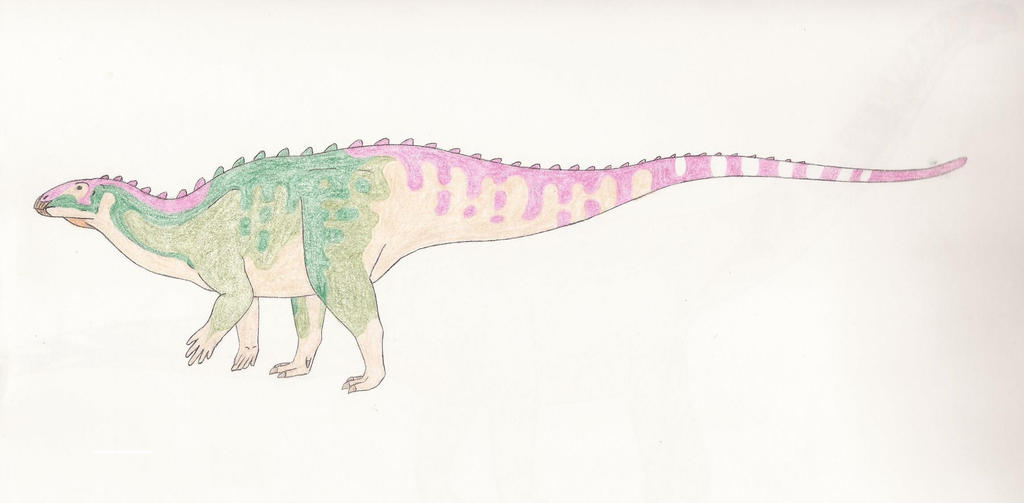
Tenontosaurus drawing

     Now that we've moved in to our new home in Texas and I've had some time to settle down, I've been sketching a few "Texasauruses" in honor of our new home state. This first one represents Tenontosaurus, the most common dinosaur in the state. It's most distinctive feature is its long tail compared to relatives like Iguanodon. It's most famous for having been discovered in association with the remains of multiple individuals of Deinonychus, a discovery which led to the hypothesis that raptor dinosaurs hunted in packs. This Tenontosaurus remains blissfully raptor-free, and sports a fancy color scheme for attracting mates. Hope you like it!

Also uploaded to my DeviantArt page

Stay tuned for more!