And I'm dusting off this old blog once again to post more links to my new site, Dino Dad Reviews! I'm not expecting anybody to read this, I'm just trying to game the algorithm.
I'll start off with a few graphic novels I've reviewed. First is Ted Rechlin's Jurassic, a day-in-the-life story of a young Brontosaurus, much in the vein of Delgado's "Age of Reptiles" series. I've also reviewed the first two entries in Abby Howard's "Earth Before Us" series, Dinosaur Empire! and Ocean Renegades! I'll be reviewing book #3 soon.
I've made a yearly habit of reviewing prehistoric shark material during shark week, with my reviews of Paleo Sharks & Safari's Prehistoric Sharks Toob last year, and Discovering Sharks & a pop-up book about Sharks & Other Sea Monsters this year.
While books are the bread and butter for Dino Dad Reviews, I do expand my focus to other media now and then. The Big Die is a runner game based on the End-Permian mass extinction, inspired by a paleontology meme group on Facebook. Sharp Teeth is a fantastic short film that plays on audience assumptions about carnivores. I also like to share favorites from my "Primeval Playlist": fun prehistoric themed songs I enjoy listening to. I've covered the music of Ray Troll & The Ratfish Wranglers as well as Professor Flynn so far. I've also recently published my first ever museum review, looking at The Whiteside Museum of Natural History in Seymour, TX.
Speaking of branching out, I've begun reviewing children's books on evolution as well, starting with Grandmother Fish and When the Whales Walked.
Here's some other miscellaneous reviews. The Adventures of Padma and a Blue Dinosaur is a combination storybook and encyclopedia that brings some much-deserved attention to the dinosaurs of India. I've reviewed a couple of fossil themed activities: the Build Your Own Dinosaurs Sticker Book, and Mike Tharme's DIY Fossil Magnets. I think Small and Tall Tales of Extinct Animals deserves more attention, as it's a charmingly illustrated book on the somber topic of animals made extinct by human hands. Similarly, the excellent Cat-in-the-Hat tie-in Once Upon a Mastodon deserves to be better known than its rather lackluster counterpart, Oh Say Can You Say Di-no-saur?
That's all for now. I'll post more links as I review more books in the future.
Tuesday, August 20, 2019

Thursday, November 8, 2018
Dino Dad Reviews
So I have a new blog called Dino Dad Reviews! This Stuckasaurus blog never did attract many visitors, so I'm mostly using this post to link to a bunch of my new posts to try to boost their standings in The Algorithm.
I was super excited to get my signed copy of Cruisin' the Fossil Coastline, a sequel to Kirk Johnson and Ray Troll's classic Cruisin' the Fossil Freeway. I love Ray Troll's art, and have a bit of a personal connection to it.
Speaking of personal connections, reading Jason Chin's Grand Canyon got me really nostalgic for the Disneyland Railroad. The Grand Canyon/Primeval World diorama is partially responsible for my dino obsession.
I'm pretty pleased with my review of The Dinosaurs of Waterhouse Hawkins, and it's proved to be a bit of a hit on my blog.
Speaking of hits, it's got nothing on the Ultimate Dinopedia (authored by the great Dino Don!), which has twice the hits of any other review on my blog!
Mammoth Is Mopey (by David Orr of Love in the Time of Chasmosaurs) is perhaps my favorite book I've reviewed so far, and I'd really like to see it in the hands of more kids everywhere!
ROAR: A Dinosaur Tour has a similar art style to Mammoth Is Mopey, though it doesn't have quite the same concern for fidelity to its subjects.
Pinnochio Rex is my most recent review, and is a great primer on the diversity of the tyrannosaur family.
That's all for now. I'm probably just going to use this blog to promote Dino Dad Reviews from now on, so if anybody stumbles upon this page, be sure to go check out that website instead!
I was super excited to get my signed copy of Cruisin' the Fossil Coastline, a sequel to Kirk Johnson and Ray Troll's classic Cruisin' the Fossil Freeway. I love Ray Troll's art, and have a bit of a personal connection to it.
Speaking of personal connections, reading Jason Chin's Grand Canyon got me really nostalgic for the Disneyland Railroad. The Grand Canyon/Primeval World diorama is partially responsible for my dino obsession.
I'm pretty pleased with my review of The Dinosaurs of Waterhouse Hawkins, and it's proved to be a bit of a hit on my blog.
Speaking of hits, it's got nothing on the Ultimate Dinopedia (authored by the great Dino Don!), which has twice the hits of any other review on my blog!
Mammoth Is Mopey (by David Orr of Love in the Time of Chasmosaurs) is perhaps my favorite book I've reviewed so far, and I'd really like to see it in the hands of more kids everywhere!
ROAR: A Dinosaur Tour has a similar art style to Mammoth Is Mopey, though it doesn't have quite the same concern for fidelity to its subjects.
Pinnochio Rex is my most recent review, and is a great primer on the diversity of the tyrannosaur family.
That's all for now. I'm probably just going to use this blog to promote Dino Dad Reviews from now on, so if anybody stumbles upon this page, be sure to go check out that website instead!
Sunday, June 4, 2017
"God's Word or Human Reason?" book review
I've been meaning to write this book review for some time now, but having a second baby around the house means a lot of my time has been eaten up lately! I've been waiting for this book ever since I first heard about the project a couple years ago, and I must say it's been worth the wait! God's Word or Human Reason is one of the better books I've ever read on the subject of creationism. It tackles the case from the perspective of five former young earth creationists; a rather unique take amongst the numerous books published on the matter. The title references a display in Ken Ham's creation museum, and sets up the book's theme that such a statement reflects an insidious false dichotomy.

This book is actually rather personal for me, but while I will go into that in some detail below, I had best describe the book itself first. How does it stack up? Each author tackles a different subject, going through a list of common creationist arguments on the topic, answering them one by one. The authors follow each of their chapters with a personal story about their experiences as young earth creationists, and their journey away from that viewpoint. The technical rigor of the scientific sections handily accomplish their goals throughout the book, and I strongly recommend this book to anyone wrestling with the evidence. The principal subjects covered include geology, radiometric dating, bird evolution, human evolution, and Biblical interpretation. The topics within these subjects range for too widely and delve far too deeply for me to recount in a single blog post; the authors do it far better than I ever could anyway! Suffice it to say I really enjoyed the read. I particularly appreciated the chapters on geology and bird evolution, though my own interests may bias me here. The bird evolution chapter also includes a dozen wonderful illustrations by Emily Willoughby of various feathered dinosaurs, beautifully presenting them as natural-looking, real animals.


Glenn Morton represents a real catch for this book. As a former full-fledged creation scientist, Morton brings a particularly poignant perspective to the table. Both his data and his personal story cut deep into the heart of the young earther narrative. I found it particularly enlightening when he examined the various competing ideas about flood geology among "mainstream" creationists. Each handily refutes each other's ideas about which rock layers record correspond to what parts of the flood process, and so one could say the flood geology has been defeated by flood geology (indeed, that is the title of a paper by Phil Senter which Morton cites that critiques the same creationists). This peek behind the curtain demonstrates that no matter how much Ken Ham insists that "the Bible says it, that settles it", the people who actually write about creationism in fact cannot settle on any kind of detailed shared narrative.
I appreciated that the final chapter of the book examined the issue from a Biblical perspective. Christian Bible scholar James Comer demonstrates the inconsistencies that arise from a so-called "plain reading" of Scripture, and demonstrates the unconscious biases that in fact determine what one consider a "plain reading" to be. I still shudder at Comer's description of the disturbing circular logic of the Cataclysm Chronology Research Group, formed with the stated goal of reinterpreting the accepted grammatical character of Hebrew (specifically the sequential nature of wayyiqtols) in order to make it conform to their presuppositions about the Noah's Flood narrative. I also found Comer's discussion of the ways in which creationism actually harms Christianity particularly enlightening.
I only have a few critiques of the book, mostly minor quibbles. Several of Willoughby's illustrations appear to come from earlier in her career. The contrast between them and her newer pieces seems quite noticeable to me, and I personally would have enjoyed seeing newer artwork. However, I can appreciate the competing priorities going into the making of a book that apparently took as long to put together as this one, and as even her earlier illustrations beat the pants off most popular dinosaur depictions, I suppose I can't truly complain.
I thought Jonathan Kane perhaps over-emphasized certain confirmed predictions made about bird evolution, particularly in the case of "Tetrapteryx" vs. Microraptor. I felt Kane could have said more about the competing ideas about bird evolution that existed in William Beebe's time, a discussion of which would have given the reader a stronger background to work with. Also, a sidebar in his chapter directs the reader to supplementary material at the Panda's Thumb blog, in a post titled Creationist Classification of Theropods (also authored by Kane). I found this information really helpful, and I wish Kane had included it in the chapter proper. However, that's mostly the nerdy, fact-consuming part of my brain talking, and this cartoon (which DOES appear in the book) more or less sums up the gist of the article.

I thought perhaps Comer's chapter on the Biblical case against young earth creationism felt perhaps a little over-complicated at times. As this issue represents the major stumbling for most American Christians, I appreciate the desire to exhaustively make one's case, but pitching it a little more towards the lay audience might give this perspective more traction. I enjoyed the chapter myself, but I also don't necessarily represent the average reader, either. If the reader would enjoy both more extensive and perhaps more approachable supplemental discussion on the topic, I recommend the blog Resurrecting Orthodoxy, by Joel Edmund Anderson. He posts on many topics, including the culture wars, but he has proven himself quite adept in particular at tackling young earthers from a Biblical perspective.
I personally would've also liked to see a chapter on whale evolution (another common creationist standby), though again, with the amount of time it took to create this book, I don't begrudge them that. Besides, whale paleontologist Hans Thewissen has already written another entire book entitled "The Walking Whales" (which I also heartily recommend) that I suppose one could consider essentially a stand-in for this hypothetical sixth topic. (As a non-believer himself, though, I suppose he wouldn't really fit with the larger character of this book.)
The authors handily anticipate most creationist arguments; however, this would normally only make for a mostly better than average entry into a very crowded marketplace. The authors' recollections of their experiences both with and as young earth creationists set this book apart, and give it an emotional impact most of the books on this subject lack. It's one thing to confront the manipulation of facts by creationist organizations, but it is quite another to see the manipulation of emotions and people on the individual level. My heart breaks for the five authors, three of whom were driven away from Christianity entirely due to their experiences. I felt rather furious on Glenn Morton's behalf at the treatment he received from his fellow young earth creationists when he attempted to enlist their help in fixing flaws he found in creationist theory. Not only did they ignore his attempts to better their own field, he fell on the receiving end of truly vitriolic personal attacks regarding his faith. The inability and unwillingness to wrestle with the hard questions ultimately did more to drive him away from the young earth camp than the ad hominem attacks, however. I'm glad he didn't lose his overall faith as a result, an outcome I would have totally understood had it come to pass.
This aspect of the book really struck a chord with me. While I don't think my history quite matches the injustice many of the authors suffered, I can nevertheless commiserate. Based on the literature presented to me throughout my life, I internalized creationism as the one true light standing against the darkness of atheism in our modern era. Consequently, though I have loved paleontology ever since I can remember, I wasted far more time on romantic fantasies about joining Ken Ham or ICR to go hunt for the Mokele Mbembe in the Congo than I ever did on actually thinking about how I might actually pursue an actual, workable career in the field.
By the time I entered college I had already begun to grow wary of troubling trends I perceived in the major creationist organizations, but a chance discovery partway through really got the wheels in my head turning. As both a Jurassic Park fanboy and a creationist who believed the assertion that reports of feathered dinosaurs were all lies, I naturally rejected any such notion as inherently ridiculous. The utterly garbage "tarred and feathered" raptors that some artists grudgingly illustrated to depict the emerging scientific consensus did nothing to quell my aesthetic revulsion to the idea. However, while searching for dinosaur images one day to turn into desktop wallpapers, I chanced upon Emily Willoughby's DeviantArt account, finding two images in particular that immediately gave me pause.


There on my computer screen were two depictions of a feathered Deinonychus, the first such illustrations I had ever seen that approached something that immediately looked plausibly naturalistic to me. I do not hyperbolize when I say this moment turned my life around. With the sudden realization that feathered dinosaurs did not have to look inherently stupid, I began to rethink the whole notion, and returned to the evidence with a newly open mind. I then saw that the fossils (and the scientists) hadn't lied; the evidence was plain to see.
Thus began the snowball effect as I began re-evaluating everything I'd ever absorbed from creationist literature, finding it wanting every time. The mainstream explanations proved consistently superior. I spent the next couple years in a state of cognitive dissonance, attempting to remain an "origins agnostic" as my former position became increasingly indefensible. A particularly strong blow came when I realized that several of my old creationist books had flat out lied to me regarding what evolution claimed about the origin of birds, as I describe in more detail in this older book review (see the image with the ostrich). The final straw came from reading Michael Behe's "Edge of Evolution". In the midst of attempting to poke wholes in the naturalistic explanations for the history of life, he nevertheless made it clear that he did not dispute that life had in fact evolved.
At this point I abandoned all pretense at agnosticism, and embraced my newfound identity as a Christian evolutionist. This led to a flowering of renewed interest and some of the first genuine effort to deepen my understanding of prehistoric life, leading me to many different books and websites that I had somehow never thought to even search for before, despite being relatively easy to find. I eventually rediscovered the art of Emily Willoughby, who had truly come into her own by this time. Upon hearing that she was collaborating with the other authors of this book, I knew I had to buy it. It gave me immense joy to know that the woman who originally shook me out of my previous creationist mindset was now author on a book formally tackling the subject, especially when I realized she and the other authors had come from backgrounds similar to mine.
Well, seeing as I ended up talking at least as much about myself compared to the book, I suppose I better wrap up. I hope God's Word or Human Reason helps change the tenor of the creation/evolution debate, exposing the false dichotomy of theism versus atheism that many assume go along with it. I wish I had had this book a decade ago. The rigid monopoly young earth creationism has among American evangelicals went a long way towards my inclination to devalue my own interests. God's Word or Human Reason has helped bolster my confidence in all that I've learned in years of study, and I hope to similarly help anyone I know going through similar experiences in the future.
In closing, go buy it now! You can find it at Amazon here: God's Word or Human Reason?

This book is actually rather personal for me, but while I will go into that in some detail below, I had best describe the book itself first. How does it stack up? Each author tackles a different subject, going through a list of common creationist arguments on the topic, answering them one by one. The authors follow each of their chapters with a personal story about their experiences as young earth creationists, and their journey away from that viewpoint. The technical rigor of the scientific sections handily accomplish their goals throughout the book, and I strongly recommend this book to anyone wrestling with the evidence. The principal subjects covered include geology, radiometric dating, bird evolution, human evolution, and Biblical interpretation. The topics within these subjects range for too widely and delve far too deeply for me to recount in a single blog post; the authors do it far better than I ever could anyway! Suffice it to say I really enjoyed the read. I particularly appreciated the chapters on geology and bird evolution, though my own interests may bias me here. The bird evolution chapter also includes a dozen wonderful illustrations by Emily Willoughby of various feathered dinosaurs, beautifully presenting them as natural-looking, real animals.


Glenn Morton represents a real catch for this book. As a former full-fledged creation scientist, Morton brings a particularly poignant perspective to the table. Both his data and his personal story cut deep into the heart of the young earther narrative. I found it particularly enlightening when he examined the various competing ideas about flood geology among "mainstream" creationists. Each handily refutes each other's ideas about which rock layers record correspond to what parts of the flood process, and so one could say the flood geology has been defeated by flood geology (indeed, that is the title of a paper by Phil Senter which Morton cites that critiques the same creationists). This peek behind the curtain demonstrates that no matter how much Ken Ham insists that "the Bible says it, that settles it", the people who actually write about creationism in fact cannot settle on any kind of detailed shared narrative.
I appreciated that the final chapter of the book examined the issue from a Biblical perspective. Christian Bible scholar James Comer demonstrates the inconsistencies that arise from a so-called "plain reading" of Scripture, and demonstrates the unconscious biases that in fact determine what one consider a "plain reading" to be. I still shudder at Comer's description of the disturbing circular logic of the Cataclysm Chronology Research Group, formed with the stated goal of reinterpreting the accepted grammatical character of Hebrew (specifically the sequential nature of wayyiqtols) in order to make it conform to their presuppositions about the Noah's Flood narrative. I also found Comer's discussion of the ways in which creationism actually harms Christianity particularly enlightening.
I only have a few critiques of the book, mostly minor quibbles. Several of Willoughby's illustrations appear to come from earlier in her career. The contrast between them and her newer pieces seems quite noticeable to me, and I personally would have enjoyed seeing newer artwork. However, I can appreciate the competing priorities going into the making of a book that apparently took as long to put together as this one, and as even her earlier illustrations beat the pants off most popular dinosaur depictions, I suppose I can't truly complain.
I thought Jonathan Kane perhaps over-emphasized certain confirmed predictions made about bird evolution, particularly in the case of "Tetrapteryx" vs. Microraptor. I felt Kane could have said more about the competing ideas about bird evolution that existed in William Beebe's time, a discussion of which would have given the reader a stronger background to work with. Also, a sidebar in his chapter directs the reader to supplementary material at the Panda's Thumb blog, in a post titled Creationist Classification of Theropods (also authored by Kane). I found this information really helpful, and I wish Kane had included it in the chapter proper. However, that's mostly the nerdy, fact-consuming part of my brain talking, and this cartoon (which DOES appear in the book) more or less sums up the gist of the article.

I thought perhaps Comer's chapter on the Biblical case against young earth creationism felt perhaps a little over-complicated at times. As this issue represents the major stumbling for most American Christians, I appreciate the desire to exhaustively make one's case, but pitching it a little more towards the lay audience might give this perspective more traction. I enjoyed the chapter myself, but I also don't necessarily represent the average reader, either. If the reader would enjoy both more extensive and perhaps more approachable supplemental discussion on the topic, I recommend the blog Resurrecting Orthodoxy, by Joel Edmund Anderson. He posts on many topics, including the culture wars, but he has proven himself quite adept in particular at tackling young earthers from a Biblical perspective.
I personally would've also liked to see a chapter on whale evolution (another common creationist standby), though again, with the amount of time it took to create this book, I don't begrudge them that. Besides, whale paleontologist Hans Thewissen has already written another entire book entitled "The Walking Whales" (which I also heartily recommend) that I suppose one could consider essentially a stand-in for this hypothetical sixth topic. (As a non-believer himself, though, I suppose he wouldn't really fit with the larger character of this book.)
The authors handily anticipate most creationist arguments; however, this would normally only make for a mostly better than average entry into a very crowded marketplace. The authors' recollections of their experiences both with and as young earth creationists set this book apart, and give it an emotional impact most of the books on this subject lack. It's one thing to confront the manipulation of facts by creationist organizations, but it is quite another to see the manipulation of emotions and people on the individual level. My heart breaks for the five authors, three of whom were driven away from Christianity entirely due to their experiences. I felt rather furious on Glenn Morton's behalf at the treatment he received from his fellow young earth creationists when he attempted to enlist their help in fixing flaws he found in creationist theory. Not only did they ignore his attempts to better their own field, he fell on the receiving end of truly vitriolic personal attacks regarding his faith. The inability and unwillingness to wrestle with the hard questions ultimately did more to drive him away from the young earth camp than the ad hominem attacks, however. I'm glad he didn't lose his overall faith as a result, an outcome I would have totally understood had it come to pass.
This aspect of the book really struck a chord with me. While I don't think my history quite matches the injustice many of the authors suffered, I can nevertheless commiserate. Based on the literature presented to me throughout my life, I internalized creationism as the one true light standing against the darkness of atheism in our modern era. Consequently, though I have loved paleontology ever since I can remember, I wasted far more time on romantic fantasies about joining Ken Ham or ICR to go hunt for the Mokele Mbembe in the Congo than I ever did on actually thinking about how I might actually pursue an actual, workable career in the field.
By the time I entered college I had already begun to grow wary of troubling trends I perceived in the major creationist organizations, but a chance discovery partway through really got the wheels in my head turning. As both a Jurassic Park fanboy and a creationist who believed the assertion that reports of feathered dinosaurs were all lies, I naturally rejected any such notion as inherently ridiculous. The utterly garbage "tarred and feathered" raptors that some artists grudgingly illustrated to depict the emerging scientific consensus did nothing to quell my aesthetic revulsion to the idea. However, while searching for dinosaur images one day to turn into desktop wallpapers, I chanced upon Emily Willoughby's DeviantArt account, finding two images in particular that immediately gave me pause.


There on my computer screen were two depictions of a feathered Deinonychus, the first such illustrations I had ever seen that approached something that immediately looked plausibly naturalistic to me. I do not hyperbolize when I say this moment turned my life around. With the sudden realization that feathered dinosaurs did not have to look inherently stupid, I began to rethink the whole notion, and returned to the evidence with a newly open mind. I then saw that the fossils (and the scientists) hadn't lied; the evidence was plain to see.
Thus began the snowball effect as I began re-evaluating everything I'd ever absorbed from creationist literature, finding it wanting every time. The mainstream explanations proved consistently superior. I spent the next couple years in a state of cognitive dissonance, attempting to remain an "origins agnostic" as my former position became increasingly indefensible. A particularly strong blow came when I realized that several of my old creationist books had flat out lied to me regarding what evolution claimed about the origin of birds, as I describe in more detail in this older book review (see the image with the ostrich). The final straw came from reading Michael Behe's "Edge of Evolution". In the midst of attempting to poke wholes in the naturalistic explanations for the history of life, he nevertheless made it clear that he did not dispute that life had in fact evolved.
At this point I abandoned all pretense at agnosticism, and embraced my newfound identity as a Christian evolutionist. This led to a flowering of renewed interest and some of the first genuine effort to deepen my understanding of prehistoric life, leading me to many different books and websites that I had somehow never thought to even search for before, despite being relatively easy to find. I eventually rediscovered the art of Emily Willoughby, who had truly come into her own by this time. Upon hearing that she was collaborating with the other authors of this book, I knew I had to buy it. It gave me immense joy to know that the woman who originally shook me out of my previous creationist mindset was now author on a book formally tackling the subject, especially when I realized she and the other authors had come from backgrounds similar to mine.
Well, seeing as I ended up talking at least as much about myself compared to the book, I suppose I better wrap up. I hope God's Word or Human Reason helps change the tenor of the creation/evolution debate, exposing the false dichotomy of theism versus atheism that many assume go along with it. I wish I had had this book a decade ago. The rigid monopoly young earth creationism has among American evangelicals went a long way towards my inclination to devalue my own interests. God's Word or Human Reason has helped bolster my confidence in all that I've learned in years of study, and I hope to similarly help anyone I know going through similar experiences in the future.
In closing, go buy it now! You can find it at Amazon here: God's Word or Human Reason?
Tuesday, April 11, 2017
Sixteen Trials (a 16 Tons parody)
In anticipation of the upcoming March for Science, I've come up with a little ditty to be sung to the tune of "Sixteen Tons", by Tennessee Ernie Ford. If you unfamiliar with the melody, see the video embedded at the bottom of the page. (My apologies if the meter is a little awkward in places.)

Sixteen Trials
(To the tune of "Sixteen Tons")
I'm a toxicologist studyin'
Human health
My enemies are lobbyists
Aflush with wealth
Insisting that we all can drink
Industrial waste
Pesticide and Cyanide
And enjoy the taste
Chorus:
You run sixteen trials,
And what do you get?
A hostile Congress that's
Screamin' 'bout debt
Senator don't call me
'Cause I can't go
I'm tryin' to discover facts
We all should know
I'm an ecologist searchin'
For animals and plants
Understanding their
Harmonious dance
But they've no monetary value
To a CEO
I'm in the way of business
They want me to go
Chorus
I'm a fossil hunter siftin'
Thru scrap from a mine
Creationists don't like
The things that I find
I've brought evidence to courtrooms
By the metric ton
Yet still they think they've got
Me on the run
Chorus
I'm a scientist creating
Vaccines for disease
Hopin' that no-one
Has to cough or wheeze
But hippies like to hound me
Like harpies so shrill
What the Right Wing doesn't ruin
The Left Wing will
Chorus
I'm a climatologist
Just doin' my thing
The GOP thinks I'm an
Illuminati king
They'll block me from findin'
A single fact
Then claim there's no info
On which to act
Chorus
Hope you liked it! Feel free to use and share as you wish. As promised, I've embedded a video of the original song below so you can get a sense of the tune. I'm a bit of a traditionalist, so I definitely recommend listening to the song as originally sung by Tennessee Ernie Ford; however, nobody can musically convey the feeling of the slog of unrewarding work quite like a choir full of former Communists.
Thursday, February 9, 2017
CSI Echinoid
This is the sort of thing you come up with when you attend a meeting on fossil sea urchins. Or maybe it's just me. lol


Tuesday, November 22, 2016
New Mexico Museum of Natural History and Science (addendum)
Social media has been rather poisoned by politics lately, so I decided the Internet could use some more dinosaurs (and other prehistoric creatures). I always meant to write another post following up on my last, featuring some of the photos I didn't include in my review of the New Mexico Museum of Natural History and Science in Albuquerque. So several months later, I've finally gotten around to it! Better late than never, I suppose.
I really liked the cabinet full of phytosaurs (I posted a pic of the whole thing last time), so we'll start with a couple of close ups! I forgot to take separate notes of the identity of species, so I can't say which is which, but one can at least get a good sense of the similarities and differences between each. Note the position of the nostrils, high on the head between the eyes like a whale's blowhole. This is the defining feature for the group, and the one that most obviously sets them apart from crocodiles.


A lovely complete specimen of an aetosaur sits on display just across from the pytosaur cabinet. Unlike phytosaurs, aetosaurs sit relatively close to true crocodiles on the tree of life, and yet could hardly look more different. These pig-nosed herbivores bore armor to protect them from more traditional-looking crocodylians as they rooted through the underbrush looking for food. Though this specimen has not been fully restored, and remains in its original, somewhat flattened state, one can clearly see the armadillo-like armor running down the length of its body.

Now, most of the people I know probably have no familiarity with any of the creatures I've shown so far, so here's a more famous creature to liven things up: everybody's favorite non-dinosaur, Dimetrodon! It's always fun to see a skeleton of one of these guys, even if recent evaluation suggests that this mount should maybe look a little more "gnarly".

Now, since you've all been so good, here's some actual dinosaurs! I really liked the Western Interior Seaway atrium, featuring ancient sea critters, as well as a forest full of dinosaurs near the shore. Hiding amongst the leaves one can find a Pentaceratops skull (complementing the statue out in front of the museum) and a family of duckbilled dinosaurs (I couldn't find any signage suggesting what species they might belong to).
A small theropod can be seen rooting around in the bushes, apparently hunting for something. Sure enough, visitors can walk into a little cave underneath the forest floor, where one can look up through a small burrow and see the predator's quarry, a small mammal, hunkering down until the coast clears.

Moving on back to the Jurassic hall, there's one piece of the main display which I left out in my previous evaluation. If one looks on the ground below the feet of the mounted skeletons, one can see recreations of the actual type material! I really appreciated this feature, as it demonstrates how little material paleontologists often have to work with, and how displays like this must be reconstructed based on elements from multiple individuals, not always of the same species.

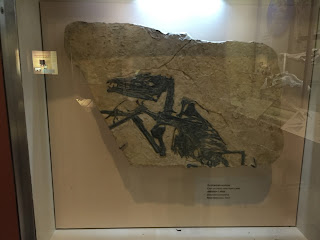
Also in the same hall, visitors can see reconstructions of a couple of Jurassic fliers. Both a pterosaur and a bird are represented. A skeleton of Eudimorphodon and several "flying" life-like models of the same fly overhead, while one of the better reconstructions of Archaeopteryx that I've personally seen squares off against its far-off descendant, a modern pigeon.


Finally, as a rabid paleoart enthusiast, I couldn't finish this post without the presence of the great Ely Kish mural that graces the Jurassic Hall. Kish's style has never been quite up my alley (her dinosaurs always look rather emaciated), but I can't deny her basic artistic skill, or the important place she occupies in the history of depictions of prehistoric life. But many famous paleoartists have contributed art to the great museums; what really makes this display stand out is the actual artist recognition the museum gives in signage every bit as prominent as that describing the fossils themselves!!! Seriously, in an age when several scandals have broken out over museums plagiarizing famous artists' work, seeing this bit of acknowledgement from 30 years ago gives me some hope that this doesn't have to be the norm.


That's all for this odds and ends post. If I ever make it back to this museum, there are several displays I neglected to photograph that I will have to make sure to document next time. (Chiefly, the "Bisti Beast", the Gastornis skeleton, and the horse evolution mural). I hope I've inspired somebody else to check this place out should they ever find themselves in Albuquerque! As I sign off, here's a bonus live lungfish in a tank that can be found amongst the Paleozoic fossils.

I really liked the cabinet full of phytosaurs (I posted a pic of the whole thing last time), so we'll start with a couple of close ups! I forgot to take separate notes of the identity of species, so I can't say which is which, but one can at least get a good sense of the similarities and differences between each. Note the position of the nostrils, high on the head between the eyes like a whale's blowhole. This is the defining feature for the group, and the one that most obviously sets them apart from crocodiles.


A lovely complete specimen of an aetosaur sits on display just across from the pytosaur cabinet. Unlike phytosaurs, aetosaurs sit relatively close to true crocodiles on the tree of life, and yet could hardly look more different. These pig-nosed herbivores bore armor to protect them from more traditional-looking crocodylians as they rooted through the underbrush looking for food. Though this specimen has not been fully restored, and remains in its original, somewhat flattened state, one can clearly see the armadillo-like armor running down the length of its body.

Now, most of the people I know probably have no familiarity with any of the creatures I've shown so far, so here's a more famous creature to liven things up: everybody's favorite non-dinosaur, Dimetrodon! It's always fun to see a skeleton of one of these guys, even if recent evaluation suggests that this mount should maybe look a little more "gnarly".

Now, since you've all been so good, here's some actual dinosaurs! I really liked the Western Interior Seaway atrium, featuring ancient sea critters, as well as a forest full of dinosaurs near the shore. Hiding amongst the leaves one can find a Pentaceratops skull (complementing the statue out in front of the museum) and a family of duckbilled dinosaurs (I couldn't find any signage suggesting what species they might belong to).
 |
Pentaceratops is named for its enlarged cheekbones, which
look like extra horns, but the most obvious differences
from Triceratops would be the holes and notch in the frill.
|
 |
I feel like the mother has the suggestion of an undeveloped crest,
which would make this a lambeosaur of some sort.
|
A small theropod can be seen rooting around in the bushes, apparently hunting for something. Sure enough, visitors can walk into a little cave underneath the forest floor, where one can look up through a small burrow and see the predator's quarry, a small mammal, hunkering down until the coast clears.

 |
The contrast is rather bad, but you can just make
out the predator's head behind the mammal.
|
Moving on back to the Jurassic hall, there's one piece of the main display which I left out in my previous evaluation. If one looks on the ground below the feet of the mounted skeletons, one can see recreations of the actual type material! I really appreciated this feature, as it demonstrates how little material paleontologists often have to work with, and how displays like this must be reconstructed based on elements from multiple individuals, not always of the same species.

Also in the same hall, visitors can see reconstructions of a couple of Jurassic fliers. Both a pterosaur and a bird are represented. A skeleton of Eudimorphodon and several "flying" life-like models of the same fly overhead, while one of the better reconstructions of Archaeopteryx that I've personally seen squares off against its far-off descendant, a modern pigeon.


Finally, as a rabid paleoart enthusiast, I couldn't finish this post without the presence of the great Ely Kish mural that graces the Jurassic Hall. Kish's style has never been quite up my alley (her dinosaurs always look rather emaciated), but I can't deny her basic artistic skill, or the important place she occupies in the history of depictions of prehistoric life. But many famous paleoartists have contributed art to the great museums; what really makes this display stand out is the actual artist recognition the museum gives in signage every bit as prominent as that describing the fossils themselves!!! Seriously, in an age when several scandals have broken out over museums plagiarizing famous artists' work, seeing this bit of acknowledgement from 30 years ago gives me some hope that this doesn't have to be the norm.


That's all for this odds and ends post. If I ever make it back to this museum, there are several displays I neglected to photograph that I will have to make sure to document next time. (Chiefly, the "Bisti Beast", the Gastornis skeleton, and the horse evolution mural). I hope I've inspired somebody else to check this place out should they ever find themselves in Albuquerque! As I sign off, here's a bonus live lungfish in a tank that can be found amongst the Paleozoic fossils.

Sunday, September 4, 2016
New Mexico Museum of Natural History and Science
This post has been a while coming (I visited it all the way back in February!), but I'm excited to finally present my review of Albuquerque's New Mexico Museum of Natural History!!! I've had the photos on my computer for months now, but this blog post kept falling by the wayside for one reason or another. Which is a travesty, because I have to say, this is probably one of my all time favorite museums that I have ever visited! I have quite a few photos to go through, so for organization's sake I'll
stick to highlights in this post and then maybe put up pictures of
interesting specifics in a later post.

The front of the museum is graced by these two beauties squaring off against each other: a generic albertosaurine tyrannosaur and a Pentaceratops, both metal sculptures by Dave Thomas. Both depict dinosaurs known from New Mexico. The albertosaur has since been more precisely identified, and is now known as Bistahieversor, or the "Bisti Beast".
Walking inside the museum, the first thing you see is this nice Coelophysis sculpture next to the admission desk. I would've looked very poorly on the museum had this little guy not been featured in some fashion, as it's the star of perhaps the most famous paleontological find in all New Mexico! A quarry at Ghost Ranch has yielded hundreds upon hundreds of specimens all tangled together a mass grave. While they appear to have died in a flooding event, a sense of mystery still hangs over the site, as nobody can satisfactorily explain why so many individuals of a single species clustered together so densely. One would expect to find equal proportions of other animals from the area, such as lizards, mammals, and other such things, but it's just Coelophysis all the way down.
As you walk into the main space of the museum, you come across Stan the T-rex on your left. "Stan" is a very well-preserved specimen (surpassed only by "Sue") discovered by the Black Hills Institute which has been molded, copied, and sold to many museum worldwide. If that T-rex skeleton you're looking at isn't made of real bone, chances are it's a cast of Stan. It was nice to run into him here! I'm not sure if I'm crazy about that pose though; it looks like he's scrambling to get onto his feet after you surprised him from a nap.
The rest of the downstairs consists mostly of boring non-dinosaur stuff, so upstairs we go! I really, really appreciated and enjoyed the set-up of the paleontology exhibits. It's arranged as a sort of "walk through time" display, with each major section numbered so you know which direction to go, starting with the beginning of the earth on through the Paleozoic. Highlights here include the phytosaur vs dicynodont mount.
I was thinking of saving this for the future odds & ends post, but I love comparitive anatomy exhibits so much that I just had to share this Wall of Phytosaurs as one of the chief highlights of the Paleozoic section. These sorts of displays really help to emphasize the diversity of life on earth, and to drive home the idea that maybe similar looking creatures aren't necessarily so same-y after all. How does a phytosaur differ from a crocodile you (probably didn't) ask? Well, if I were going to boil it down to a single layperson-friendly feature, you can see here that the nostrils sit above the eyes on the forehead in a whale-like fashion, as opposed to the tip of the snout as in modern crocs.
Now on to the dinosaurs! The next leg of the museum's "walk through time" takes us to the Jurassic Period, with two of its largest residents taking center stage. The starts are the skeletal mounts of a Saurophaganax chasing down an enormous sauropod once known and here labeled as Seismosaurus halli, though it has since been referred to another genus, becoming instead Diplodocus hallorum. D. hallorum was once hailed as the longest dinosaur of all time, though it has since ceded that title to Supersaurus. Incidentally, the titles of longest, tallest and heaviest dinosaur are each individually held by completely separate dinosaurs, so if you ever hear somebody simply refer to "the biggest" dinosaur, make sure to pay attention to which measurement they're actually talking about. Saurophaganax is a bit easier, as there don't appear to have been any Jurassic meat eaters that approached in scale by any measurement (though it's still plenty smaller than "Seismosaurus"!). You can just see a Stegosaurus on the right, but I'll save that for a later post.
If I may draw your attention to the mural behind the skeleton, I was quite pleasantly surprised to discover that it was painted by none other than famed paleoartist Ely Kish. She's not my favorite paleoartist, but she's still pretty handy with a brush, and it was fun seeing it in person.
To the left of this hall's main attraction stood this massive Brachiosaurus forelimb. It was conveniently placed so that one can stand next to it for a picture, which I did of course. Fun fact! Brachiosaurus means "arm-lizard", in reference to the fact that it's forelimbs are much longer than it hindlimbs, in a reversal of the usual dinosaur body plan, giving the creature's body a distinct sloping back.
Next up on our walk through time, we come to the Cretaceous seashore, represented by this lovely atrium and wonderful diorama. There forested area houses several dinosaur models hiding amongst the shrubs, and opposite in the "water" sits a mosasaur, a hesperornith (a prehistoric diving bird) and some ammonites swimming alongside each other. It's fun exploring the area to see what you can find! I found the skeleton of the "Bisti Beast" in here, though I forgot to take a picture. There's also a little tidepool exhibit with some live critters inside which they presumably open up for field trips to play with.
The paucity of prehistoric mammals and other Cenezoic creatures was the only part of the walk through time that I felt was somewhat lacking, though I did appreciate seeing a mammoth right next to a mastodon skull so you could easily compare them (hint: it's all about the teeth). Comparative anatomy for the win again! I am very unhappy however to discover that I somehow forgot to take pictures of a lovely Gastornis skeleton and a nice mural of the various stages of horse evolution. Oh well! Perhaps next time.
That's all for now! The museum contains tons of smaller specimens which I didn't cover here, as well as several whole non-paleontology themed areas I didn't even have time to visit. I'll write up another blog post soon to cover the stuff I did take pictures of later.
If you're ever in Albuquerque, NM, be sure to stop by the natural history museum! It's well worth your time, and easily one of the best museums I've been to so far. (Extra points for having the single best-stocked gift shop I've ever seen in my life!) I'm sure there's plenty I missed; was on a tight time schedule on my last visit and had to cut my visit shorter than I would have liked. I really hope I get the chance to go back myself someday!

The front of the museum is graced by these two beauties squaring off against each other: a generic albertosaurine tyrannosaur and a Pentaceratops, both metal sculptures by Dave Thomas. Both depict dinosaurs known from New Mexico. The albertosaur has since been more precisely identified, and is now known as Bistahieversor, or the "Bisti Beast".
 |
| "Alberta", the tyrannosaurid |
 |
| "Spike", the Pentaceratops |
Walking inside the museum, the first thing you see is this nice Coelophysis sculpture next to the admission desk. I would've looked very poorly on the museum had this little guy not been featured in some fashion, as it's the star of perhaps the most famous paleontological find in all New Mexico! A quarry at Ghost Ranch has yielded hundreds upon hundreds of specimens all tangled together a mass grave. While they appear to have died in a flooding event, a sense of mystery still hangs over the site, as nobody can satisfactorily explain why so many individuals of a single species clustered together so densely. One would expect to find equal proportions of other animals from the area, such as lizards, mammals, and other such things, but it's just Coelophysis all the way down.
 |
| I can't find a credit, so I assume Dave Thomas also sculpted this. |
 |
| This block full of Coelophysis appears further inside the museum, but I thought I'd include it here for reference. |
As you walk into the main space of the museum, you come across Stan the T-rex on your left. "Stan" is a very well-preserved specimen (surpassed only by "Sue") discovered by the Black Hills Institute which has been molded, copied, and sold to many museum worldwide. If that T-rex skeleton you're looking at isn't made of real bone, chances are it's a cast of Stan. It was nice to run into him here! I'm not sure if I'm crazy about that pose though; it looks like he's scrambling to get onto his feet after you surprised him from a nap.
 |
| "Just gimme a sec! If only I could do a proper push-up..." |
The rest of the downstairs consists mostly of boring non-dinosaur stuff, so upstairs we go! I really, really appreciated and enjoyed the set-up of the paleontology exhibits. It's arranged as a sort of "walk through time" display, with each major section numbered so you know which direction to go, starting with the beginning of the earth on through the Paleozoic. Highlights here include the phytosaur vs dicynodont mount.
 |
| Or Not-a-croc vs Not-a-pig, if you prefer. |
 |
| (Not A) Croc Cabinet |
Now on to the dinosaurs! The next leg of the museum's "walk through time" takes us to the Jurassic Period, with two of its largest residents taking center stage. The starts are the skeletal mounts of a Saurophaganax chasing down an enormous sauropod once known and here labeled as Seismosaurus halli, though it has since been referred to another genus, becoming instead Diplodocus hallorum. D. hallorum was once hailed as the longest dinosaur of all time, though it has since ceded that title to Supersaurus. Incidentally, the titles of longest, tallest and heaviest dinosaur are each individually held by completely separate dinosaurs, so if you ever hear somebody simply refer to "the biggest" dinosaur, make sure to pay attention to which measurement they're actually talking about. Saurophaganax is a bit easier, as there don't appear to have been any Jurassic meat eaters that approached in scale by any measurement (though it's still plenty smaller than "Seismosaurus"!). You can just see a Stegosaurus on the right, but I'll save that for a later post.
 |
| Someone's bitting off more than he can chew... |
If I may draw your attention to the mural behind the skeleton, I was quite pleasantly surprised to discover that it was painted by none other than famed paleoartist Ely Kish. She's not my favorite paleoartist, but she's still pretty handy with a brush, and it was fun seeing it in person.
To the left of this hall's main attraction stood this massive Brachiosaurus forelimb. It was conveniently placed so that one can stand next to it for a picture, which I did of course. Fun fact! Brachiosaurus means "arm-lizard", in reference to the fact that it's forelimbs are much longer than it hindlimbs, in a reversal of the usual dinosaur body plan, giving the creature's body a distinct sloping back.
 |
| It's always arm day with Brachiosarus |
Next up on our walk through time, we come to the Cretaceous seashore, represented by this lovely atrium and wonderful diorama. There forested area houses several dinosaur models hiding amongst the shrubs, and opposite in the "water" sits a mosasaur, a hesperornith (a prehistoric diving bird) and some ammonites swimming alongside each other. It's fun exploring the area to see what you can find! I found the skeleton of the "Bisti Beast" in here, though I forgot to take a picture. There's also a little tidepool exhibit with some live critters inside which they presumably open up for field trips to play with.
 |
| A little "cave" on the left lets you look up trough a burrow into the diroama |
 |
| Just "offshore" lurks a mosasaur, looking to snag the real chicken of the sea |
The paucity of prehistoric mammals and other Cenezoic creatures was the only part of the walk through time that I felt was somewhat lacking, though I did appreciate seeing a mammoth right next to a mastodon skull so you could easily compare them (hint: it's all about the teeth). Comparative anatomy for the win again! I am very unhappy however to discover that I somehow forgot to take pictures of a lovely Gastornis skeleton and a nice mural of the various stages of horse evolution. Oh well! Perhaps next time.
 | |
| Mammoth and Mastodon skulls, for comparison. The Mastodon had its tusks removed to save space. |
 |
| A sabertooth cat menaces the poor pachyderms. |
That's all for now! The museum contains tons of smaller specimens which I didn't cover here, as well as several whole non-paleontology themed areas I didn't even have time to visit. I'll write up another blog post soon to cover the stuff I did take pictures of later.
If you're ever in Albuquerque, NM, be sure to stop by the natural history museum! It's well worth your time, and easily one of the best museums I've been to so far. (Extra points for having the single best-stocked gift shop I've ever seen in my life!) I'm sure there's plenty I missed; was on a tight time schedule on my last visit and had to cut my visit shorter than I would have liked. I really hope I get the chance to go back myself someday!
Subscribe to:
Posts (Atom)